New website
Finally my new website is up and running and a new version of this blog has been created which will now only be updated and accessible from the blog link from the website.
Inspired by Heritage exhibition
During 2009 I was artist in residence at Newby Hall, Ripon, a private Georgian family home as part of the Inspired by Heritage project organised by Art Connections and funded by the Esmée Fairbairn Foundation. An exhibition of the work opens on Friday 11th June at The Mercer Art Gallery, Harrogate along with the five other artists who were based at other heritage locations in North Yorkshire.

The Spring Clean
THE MERCER ART GALLERY
Swan Road
Harrogate
North Yorkshire
HG1 2SA
01423 556188
11th June to 18th July 2010
Tues to Sat 10am to 5pm, Sun 2pm to 5pm, closed Mondays except Bank Holidays.
ADMISSION FREE
If anyone is in Harrogate tomorrow evening please come along to the Private View between 6 and 8 pm.
On Saturday, I will be running a family workshop at the gallery making postcards using various photography and digital techniques, there are 2 sessions 10 am – 12 noon or 2 – 4pm, £5 per session. There are some places still available on both sessions, please email elaine.laker@harrogate.gov.uk to reserve a place.
North Yorkshire Open Studios
I will be at South Street Gallery, Scarborough on Friday and Sunday of this week (11 and 13 June) and next weekend (19 and 20 June) as part of North Yorkshire Open Studios www.nyos.org.uk, if you would like to pop along and say hello!
On show will be a selection of images from Home Work which explores domestic labour in and around Hanoi, Vietnam.

6-8 South Street
South Cliff
Scarborough
YO11 2BP
01723 506010
The opening hours are as follows:
Thursday 10th, 12-5pm
Friday 11th NYOS 10.30 – 5.30pm
Saturday 12th NYOS 10.30 – 5.30pm
Sunday 13th NYOS 10.30-5.30pm
Thursday 17th, 12-5pm
Friday 18th, 12-5pm
Saturday 19th NYOS 10.30-5.30pm
Sunday 20th NYOS 10.30-5.30pm
Finland
Tomorrow I will be heading off back to Finland to undertake the second half of my residency at Jyväskylä Printmaking Centre and taking a short trip east to Finnish Karelia. I’m struggling to believe that the temperature is really in the late 20s when it was so cold on my last trip! I will be back in the UK on Monday 7th June but should be easily contactable by email and mobile phone during that time. As well as my usual mobile number my Finnish mobile is +358 (0)41 724 1355.
Sadly, though it has meant that I won’t be present when Home Work comes off the press as next Tuesday and Wednesday the book will be being printed at EBS in Verona, Italy.
Portraiture
Julia Margaret Cameron Award
I was pleased to find out recently that 3 of my portraits of women from Vietnam and China have reached the final of the portrait section of The Julia Margaret Cameron Award. The winners are now being selected by the jurors’ team and will be announced in the last week of June.
The Photographers’ Gallery commission
I’m also very pleased to be selected to participate in an ambitious project by The Photographers’ Gallery to coincide with the 2012 Olympic Games in London. With 205 nations competing in the 2012 Olympics, the project will feature 205 portrait photographs of 205 Londoners (one from each nation) by 205 UK and international photographers. The final images will be exhibited as a public art project across London during 2012.
New commission
I am pleased to announce that I have been selected to undertake a commission to create an exhibition of new photographic work and archival material about the Hereford breed of cattle for the Hereford Photography Festival in October, www.photofest.org
Gallery representation
I’m pleased to announce that I am now represented for print sales by Zoe Bingham Fine Art, a new private gallery in central London.
Visit http://www.zoebingham.com to participate in an online silent auction beginning with the launch of the website on Monday 12th April. Auction ends 10pm Sunday, 2nd May. Also visit her website to see the artists whose work she is currently representing.
The inaugural selling exhibition is: Dorothy Bohm – Vintage Photographs from 15th May to 26th June.
Home Work will be exhibited at the gallery from 3rd July to 21st August, 2010.
Viewings strictly by appointment only. Open Tuesday to Saturday. To make an appointment contact: info@zoebingham.com tel: +44 (0)7920 520 777
Download a pdf about the gallery’s programme here: Zoe Bingham Fine Art Press Release
Download a pdf about the Home Work exhibition here: Tessa Bunney Press Release 2010
Morocco
I’m heading off tomorrow for a week in Morocco returning on 10 April. I’m not sure what kind of mobile phone reception or email there might be in the mountains so please leave me a message and I’ll get back to you on my return.
Finland update
As Finland comes out of its long dark winter towards spring, the sunshine has put everyone in a good mood and I’ve had no problem in finding people willing to be photographed doing their chosen activity on the frozen lakes.
I’m steadily working my way around the ice swimming holes in and around Jyväskylä and with uncannily good luck have found people swimming at all of them and willing to be photographed. I’ve been shooting on film so photos will have to follow later as nowhere here processes 120 film – I haven’t met a single photographer here who uses film either. Luckily my digital back has highlighted another technical lesson learnt: don’t try to wedge your tripod leg in a pile of snow as it very slowly slips and all the pictures are shaky – in fact I’ve gone back to hand holding because every surface is either snow or ice. However, the tripod makes a handy snow depth gauge! Also don’t trust a bus driver to tell you when to get off either…
Despite the generally sunny weather there has been a few inches of snow and it soon cools off in the evening – on my way back from Vuorilammen sauna and ice swimming spot at 6pm it was already minus 10! Heading back there this weekend to do some more portraits in this stunning location.
Spending all this time on the lakes, I’ve been fascinated how the division between the land and water has disappeared.
The sauna and swimming opens at 3pm today so I had a short time this morning to make a visit to Köhniönjärvi where there is an ice swimming place but this year it is not in use, the old ladies in the area liked to use it but it has been closed due to vandalism. About 12cm of snow fell last night and early this morning and then it started to rain so it wasn’t the easiest trip by bus and the lake was deserted.

Vuorilammen sauna ice swimming hole

Vuorilammen sauna ice swimming hole
The first few days
Thursday 11 March
I’m in the flat. There’s no television on. There’s no happy 4 year old child. There’s no internet. I can hear traffic and its raining. I’ve started knitting some socks but I’m thinking about the residency at the same time.
It’s taken us almost two days to get here with an overnight in Helsinki. It’s cold but not as cold as I expected and its started to rain. There are big piles of dirty snow everywhere.
I wanted to get off the train all the time to take pictures.
I’m here with Debby who is also part of the Connections North project but she goes back next week and I’ll be here alone. We both want to get started and it seems its taken an age to get here.
Sunday 14th March
The frozen lakes have not disappointed. I spent yesterday at Jyväsjärvi which is the nearest lake to the printmaking centre, just over the railway line. I suppose you could describe it as an urban park as its surrounded by housing. It has a specially made ice skating track and the rest of the lake is used by ski-ers, dog walkers and as a shortcut from the houses on the otherside into town.

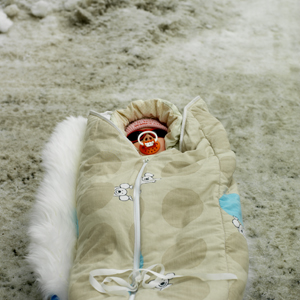
Today, I spent the morning at Tuomiojärvi, a much quieter lake north of the town in a residential area. The main draw was to check out the ice swimming spot, there were a few people braving the water but I couldn’t get close enough to talk to them as it had a private entrance. I then spotted a few ice fishermen on the otherside of the lake, I think its going to take a while to get used to walking across the lakes – there’s probably around 10 inches of snow on top of the ice so every now and then your leg disappears and you think that’s it! Its also proving a bit technically tricky with all that white stuff in the frame.
On Friday, I had visited the ice swimming office in town and they had told me that there was a special sauna and swimming spot open this afternoon at Tikkakosken, about 20 km north of Jyväskylä in a military zone. Debby and I only had one swimming costume between us so I very graciously (!) forwent the experience in favour of taking photos. It was a beautiful spot and the three older women who didn’t speak a word of English were happy to be photographed, thank goodness for the letter Anna-Leena had written for me… It’s got a lot colder and is snowing again today.

 Tessa Bunney News